


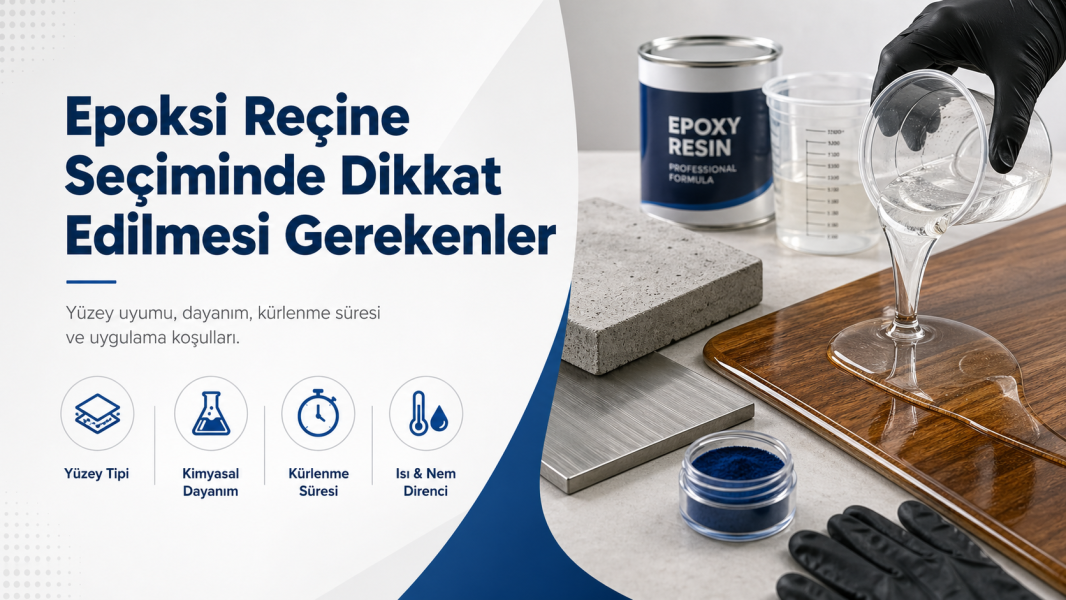
Key Considerations in Epoxy Resin Selection
Epoxy resin is a specialized chemical system widely used across many industries due to its strong adhesion, chemical resistance, mechanical strength, and long-lasting protection. It is used in floor coatings, industrial surface protection, marine applications, automotive, wood processing, composite manufacturing, electronic insulation, and decorative designs. When selected correctly, epoxy resin delivers high performance and durability on the applied surface.
However, not all epoxy resins have the same properties. Application area, surface type, environmental conditions, curing time, durability requirements, and application method directly affect the correct product choice. Therefore, instead of focusing only on price, epoxy resin should be selected based on technical requirements.
What Is Epoxy Resin?
Epoxy resin is typically a two-component system consisting of resin and hardener. After application, it cures through a chemical reaction and forms a hard, durable, and protective layer with strong adhesion.
Epoxy resins can be applied on concrete, metal, wood, fiberglass, composite surfaces, and various industrial materials, making them highly versatile for both professional and specialized applications.
Choosing Based on Application Area
The most important factor in epoxy selection is the intended application.
Industrial flooring requires high abrasion resistance, impact strength, and chemical durability.
Decorative applications prioritize transparency, UV resistance, and surface gloss.
Electronic applications require electrical insulation, moisture resistance, and heat stability.
Therefore, the application purpose must be clearly defined before selecting the resin.
Surface Type and Adhesion Strength
Proper adhesion between epoxy and the surface is essential for performance.
Concrete surfaces must be clean, dry, and dust-free.
Metal surfaces must be free from rust, oil, and old coatings.
Poor surface preparation significantly reduces performance, even with high-quality epoxy.
Mechanical Strength and Chemical Resistance
Mechanical durability is critical in high-traffic or heavy-load environments such as factories, warehouses, laboratories, and parking areas.
Chemical resistance is also important in environments exposed to oils, fuels, solvents, acids, and cleaning agents.
Correct selection prevents cracking, peeling, and premature wear.
Heat, Moisture, and UV Resistance
Environmental conditions strongly influence epoxy performance.
Indoor applications can use standard epoxy systems.
Outdoor applications require UV-resistant systems to prevent yellowing.
Moist or humid environments require water-resistant formulations and proper surface moisture control.
Curing Time and Application Ease
Epoxy systems vary in working time and curing speed.
Fast-curing systems are suitable for quick-return-to-service applications.
Slower systems are better for large surfaces, casting, or detailed work.
Temperature also affects curing behavior.
Mixing Ratio and Technical Compatibility
Epoxy resins are two-component systems that must be mixed in correct ratios. Incorrect mixing can lead to soft surfaces, incomplete curing, or performance loss.
Technical datasheets should always be followed carefully.
Transparency, Color, and Aesthetic Requirements
For decorative applications, visual properties are critical:
Transparency
UV resistance
Bubble-free finish
Gloss level
Color stability
These factors are especially important for wood casting, art designs, and decorative flooring.
Why Proper Selection Matters
Incorrect epoxy selection can lead to:
Cracking
Peeling
Discoloration
Weak adhesion
Short service life
Proper selection ensures durability, efficiency, and long-term performance.
Conclusion
Epoxy resin selection is not just a purchasing decision but a technical process that determines application success. Choosing the right system based on usage area, surface type, environmental conditions, and performance requirements ensures durable, reliable, and high-quality results in all applications.